
How Arrest Warrants Work in Worth County
An arrest warrant is judicial authority to take a named person into custody on probable cause. Worth Magistrate Court lists applications and issuance of arrest warrants among its duties. Law enforcement can also open an investigation that lands in another proper court. The Sheriff's Warrants Division handles service and status routing. A clerk keeps the linked court record. Anyone seeking public confirmation should ask for identity, current status, issuing court, warrant type, issue date, and any releasable bond or recall details. That is a narrow request, not a demand for an investigative narrative or private data. Worth County publishes no live warrant index. A blank website page, in other words, cannot establish that no warrant exists.
Worth County Probable-Cause Review
Worth County's pre-warrant process shows who really decides. The judge makes the probable-cause call, not the applicant. The applicant may present evidence and witnesses at a hearing. The respondent may cross-examine. A misdemeanor application needs a police report, while felony allegations must go through the proper law-enforcement agency first. Filing an application is not the same as issuance. The Magistrate Court procedure page links the official form and explains the hearing. Its $20 fee covers the citizen pre-warrant application, not a check for an existing arrest warrant. Georgia Act 482 took effect July 1, 2026 and changed the notice and service rules tied to warrant-application hearings, so the court's current instructions control.
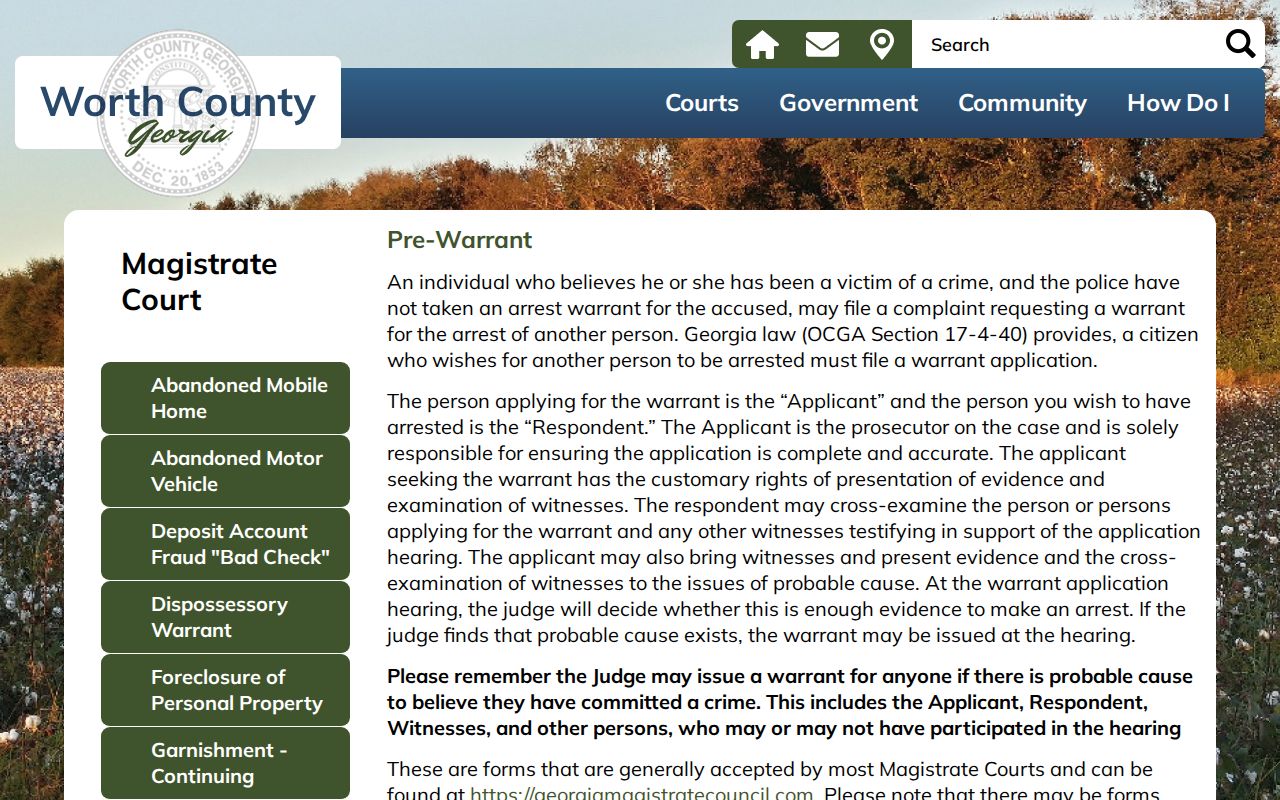
The official narrative shows the steps before a judge decides whether process should issue.
Worth County Warrant Hearing Reform
The Georgia General Assembly record for HB 1131 documents the change to warrant-application hearing notice that touches Worth County.
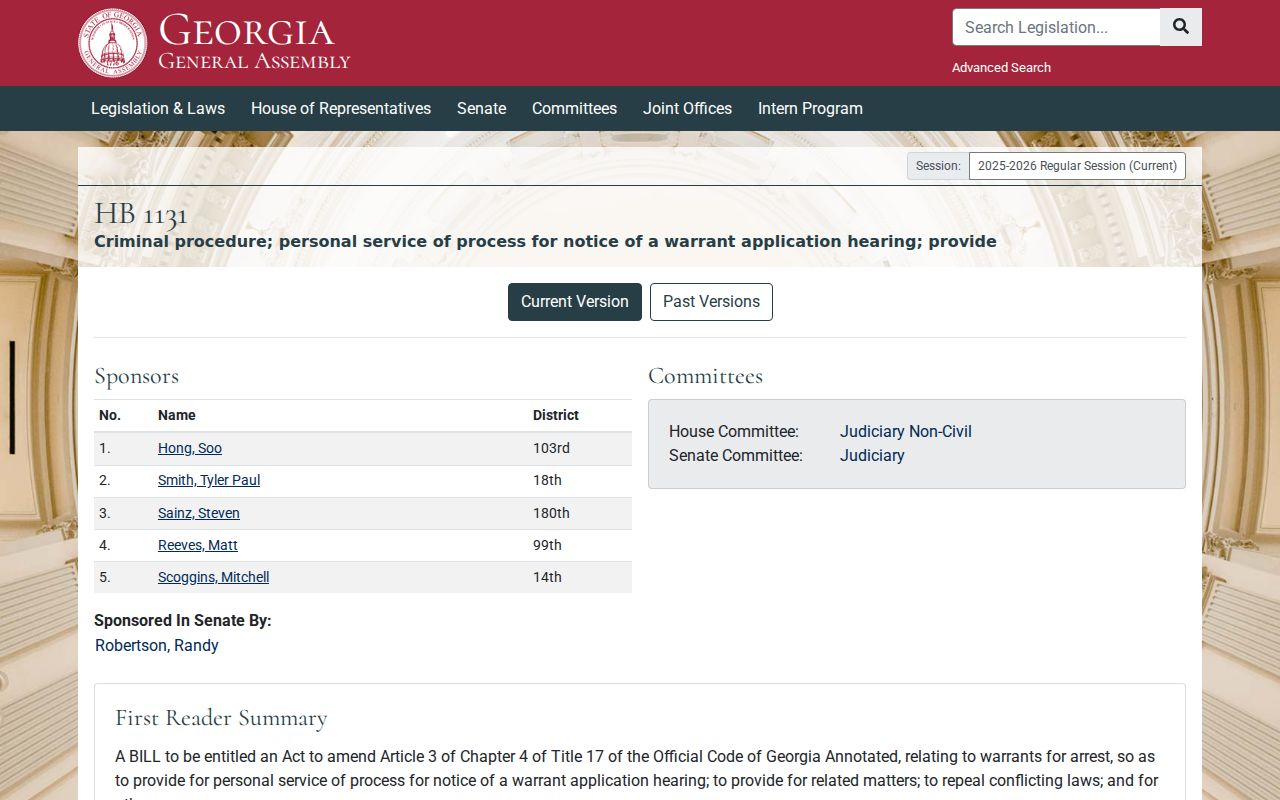
With the reform in force, current Worth County Magistrate Court instructions beat any older summary of the notice process.
Arrest Warrants: What They Contain
A good request names what you want. Ask for the subject's identity key, warrant or case number, issuing court, type, alleged offense, issue date, status, return date, bond or hold information, serving agency, and disposition. Those are prompts, not a promise that every Worth County file shows every field. A sample like WC-AR-2026-#### is only an illustration. It is not a verified local numbering pattern.
| Identity | Name and enough lawful detail to distinguish similar records |
|---|---|
| Authority | Issuing court and judicial process type |
| Status | Ask whether active, served, returned, recalled, or otherwise disposed |
| Service | Serving agency and return, when public |
| Case link | Case number, charge, bond, or disposition if releasable |
Arrest Warrant Versus Search Warrant
Worth Magistrate Court handles both arrest and search warrant functions, but the two papers authorize different acts. An arrest warrant authorizes custody of a named person. A search warrant authorizes a defined search for described evidence. The person tied to searched property is not always the person named for arrest. Search warrant affidavits can expose investigative methods, sources, addresses, or facts tied to a pending prosecution. Under the Georgia Open Records Act, some of that material may be withheld or redacted. So ask for the particular warrant, its return, and the segregable non-exempt parts rather than assuming the whole affidavit is public. For either type, give the date, agency, case number, or property description you know. Worth County clerks can work with whatever identifiers you bring.
How Warrants Get Served in Worth County
The Worth County Sheriff's Office is the central serving contact. Municipal police may serve process tied to Sylvester, Poulan, or Warwick cases, and other authorized agencies may act on warrants in their own jurisdiction. The agency that made an arrest is not always the court that controls the case. For routing, the Sheriff's contact directory lists Office Manager Kannetha Clem with the Warrants Division. Call 229-776-8211 during the published weekday office hours, or after-hours dispatch at 229-776-8219. The office sits in Room 14 at 201 N Main St in Sylvester. There is no dedicated warrant line or warrant-counter hours, so call before you travel. Staff may require government ID in person.
Inmate Results Are Not Worth County Warrants
A booking record answers one question: was someone detained? It may show arrest or release dates, charges, and photos. It does not establish that a Worth County arrest warrant remains active. A warrant can be served, recalled, returned, or tied to a court action a detention page never captures. Read the official Worth inmate lookup description with that limit in mind. Its neighboring current-charges-and-bonds page is marked "Coming Soon," so it is not a live warrant or bond roster. For current status, use the Sheriff and the issuing court. Never copy booking photos or private-person details anywhere public.
Arrest Warrants, Summonses, and Bench Warrants
The label on the paper shapes the right response in Worth County. An arrest warrant follows probable cause and authorizes arrest. A summons directs a person to appear without being an arrest warrant itself. A bench warrant or FTA order usually grows from a missed court duty in an existing case. A search warrant authorizes a search, not custody.
| Process | Main function | First Worth County contact |
|---|---|---|
| Arrest warrant | Authorizes arrest after probable cause | Sheriff Warrants Division and issuing court |
| Summons | Directs an appearance | Court named on the document |
| Bench warrant or FTA | Addresses missed court or noncompliance | Clerk of the court controlling the case |
| Search warrant | Authorizes a defined evidence search | Issuing clerk or Sheriff Open Records |
Worth County Arrest Warrant Access
Call the Worth County Sheriff at 229-776-8211 first. A phone inquiry is the quickest status check. Have the exact legal name and date of birth ready, since Georgia's guidance asks for both. Ask whether the warrant is active, which court issued it, what type it is, and whether bond or recall details can be shared. Ask what ID to bring too. Phone answers have limits, though. They are not a statewide clearance. For a copy of an existing record, use Sheriff Open Records, email openrecords@worthcosheriff.com, or choose mail or an in-person review. Describe the warrant, application, return, disposition, or recall order you want, and request a fee estimate along with the non-exempt portions. The form cites a three-business-day response practice, though full production can take longer with an explanation.
Handling an Arrest Warrant in Your Name
An active warrant in your name carries a real custody risk. Georgia guidance warns that appearing in person where an active warrant exists can mean immediate custody. So call first. Bring in a Georgia criminal-defense lawyer when a felony, disputed identity, search warrant, sealed record, or likely arrest is involved. A Worth County defense attorney can identify the issuing court, examine the docket, discuss bond, and plan a lawful appearance or surrender.
- Confirm the exact identity and ask which court and agency hold the record.
- Have counsel check whether the process is active and what appearance is required.
- Ask about bond without treating general timing as a case-specific promise.
- Follow the Sheriff and court instructions for a planned appearance.
- Keep the disposition, receipt, bond papers, and any recall order.
Safety note: Do not approach a complainant or try to investigate allegations yourself; use counsel, the court, and law enforcement.
Worth County Misdemeanor Warrant Routing
The Worth County Solicitor General page lays out how misdemeanor warrants and citations move through the county's courts.
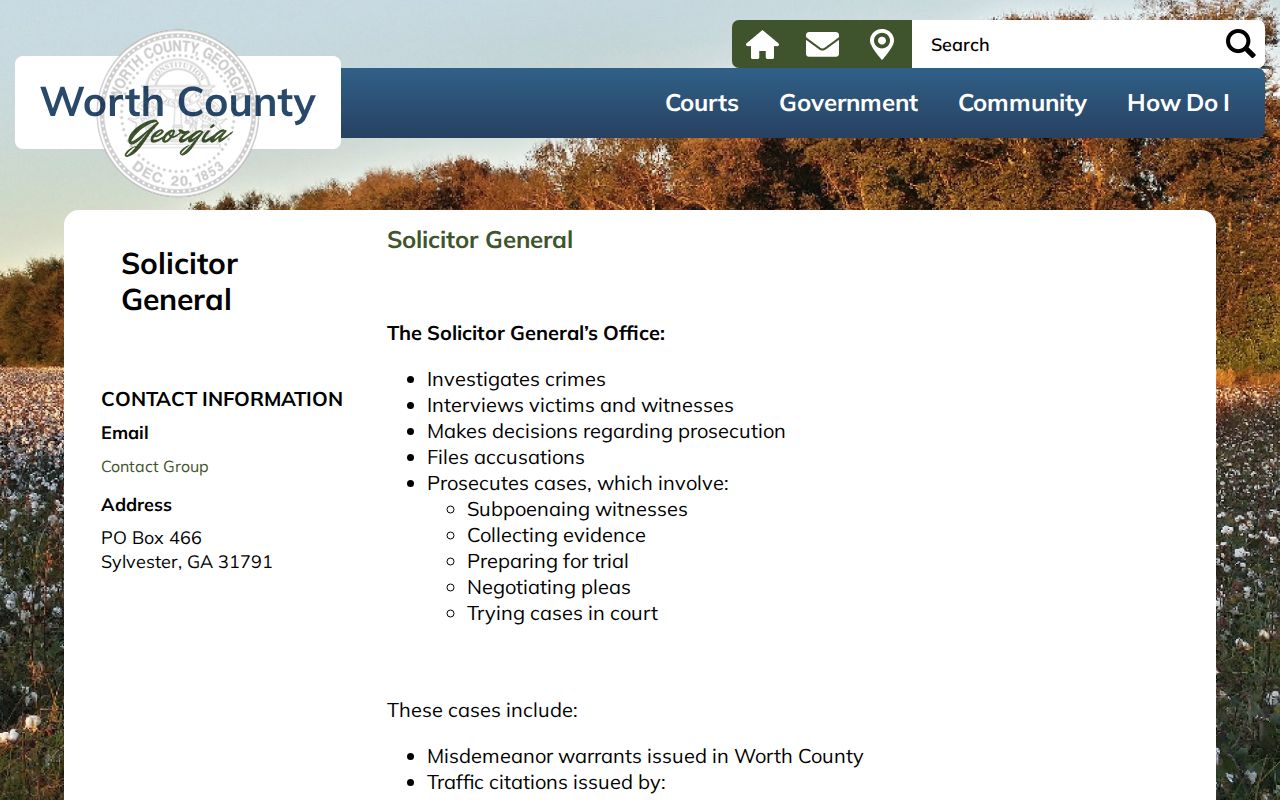
That job sits apart from the Superior Court felony clerk and from the Worth County Sheriff, who serves the papers.
Worth County Clerk Warrant Files
The Worth County Clerk of Courts page says it plainly. The office files criminal cases and keeps the criminal warrants on record.
So the Clerk is a key place to ask. Worth County publishes no live name-based warrant list, but the files exist in that office.
Worth County Court and Record Boundaries
Worth County runs its cases through several courts. Superior Court is the felony trial court, and Clerk Marcia Kimbro-Inman's office at 201 N Main St keeps the criminal filings and warrants for it. State Court takes misdemeanors and traffic matters. Magistrate Court handles warrant applications and preliminary hearings. City ordinance and traffic cases stay with each municipal court. Ask which court issued the document first, and you save yourself wasted calls. Some files will be off limits. Juvenile, sealed, expunged, and pending investigative records can be restricted, and the Georgia Open Records Act shields certain personal, medical, financial, and identifying details. A refusal means only that no record was provided within the scope you asked for. It does not prove anything statewide. If the Worth County Sheriff is not the right office, ask which court or agency is. When you make a request, name the rough date, the agency, the court, and the type of document. Ask for a warrant, an application, a return, a recall or quash order, a bond record, or a disposition, not a broad investigative file. Get a cost estimate too, and ask for any segregable public part. The Sheriff's local schedule lists $0.10 per page, no charge for ten pages or less, and the first fifteen minutes free. Those are copy rules only, not an arrest-warrant search fee and not a bond amount.